clauseo is not a chatbot
i'm not going to be humble about this.
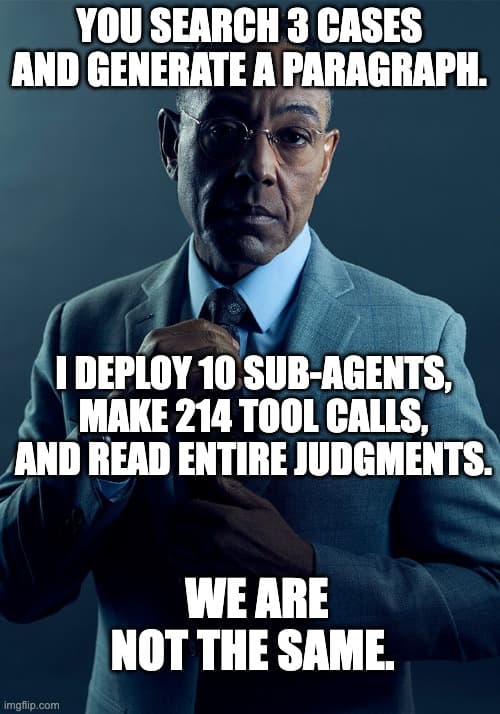
i'm not going to be humble about this.
i built the most advanced legal research agent in india. i genuinely believe that. lawyers who've used it genuinely believe that. one of them called it "human replacement territory." another said it was a "generation leap in technology." a lawyer who had actually worked on two of the exact cases in the output, who had litigated those petitions themselves, went through the research memo and said "very thorough, correct position of law, I've run GPT simulations on this very proposition to demonstrate hallucinations, this was really good."
and none of that matters. because most people will never try it. they'll see the landing page, read "ai legal research," and pattern-match it into the same bucket as every other legal ai chatbot they've seen. they'll assume it does three shallow searches, hallucinates a case name, and gives you a confident-sounding paragraph that's frequently wrong. because that's what every other legal ai does. and they'd be right about every other legal ai.
they'd be wrong about this one.
the thing i'm angry about
every company in this space ships the same thing. take a large language model. give it a legal-sounding system prompt. connect it to a search api. call it an ai research agent. ship it.
the output is always the same. surface-level answers. hallucinated case names. citations that don't exist or link to the wrong case. it searches a little, reads a little, dumps three judgments into its context window, and gives you something that sounds like it knows what it's talking about. it doesn't.
and because fifty companies shipped that and called it "ai-powered legal research," the phrase means nothing now. the words got hollowed out before the real thing even shipped.
why they're all like this
they're not stupid. they're trapped.
ai is not saas. in traditional software, serving one more user costs almost nothing. a flat monthly subscription works fine. ai is different. every query burns compute. every token costs money. every sub-agent, every tool call, every minute of runtime has a direct cost.
when you charge a flat monthly fee for an ai product, you've created a business where your survival depends on users not going too deep. the deeper the research, the more it costs you. so you route queries to cheaper models when you think nobody will notice. you cap how many searches the agent can run. you limit how long it can think. you make it a chatbot that responds in 15 seconds instead of an agent that works for 20 minutes. because the 20-minute agent would bankrupt you.
there's a product. built by harvard grads. made in india. their entire monthly subscription costs less than a single clauseo session. their plan gives you 99 sessions for that price. that's about ₹7 per session. we spend ₹750 on a single session. which one do you think goes deeper? they're proud of getting cheaper, too. they'll announce they cut pricing 77% through "innovations in inference cost." which means they figured out how to burn less compute per query. which means the output got shallower. they made the product worse and framed it as a feature.
and it's not just the cheap ones. companies in this space with billion-dollar valuations, enterprise contracts with the biggest law firms. some of them even run opus under the hood. they still ship a chatbot. one context window. a handful of searches. a confident paragraph. they chose the easy problems. drafting, summarization, document Q&A. and called it "ai for lawyers." none of them do research. because research means letting an agent run for 20 minutes, spawn sub-agents, execute code, read entire judgments. that costs real money. their business model can't absorb it.
think about it like this. if a lawyer charged a flat monthly retainer for unlimited work, would they spend 40 hours on your case when they could spend 4? every additional hour is money out of their pocket. the incentive is to do the minimum. to send the "good enough" memo and move on. subscription ai has exactly the same problem. the model rewards doing less.
we don't play that game. we're not competing with chatgpt. they are. we're competing with the junior associate's salary. the question isn't "is this better than a chatbot." it's "is this good enough to replace days of human work." and to answer that with yes, you need the best model on the planet running for as long as the research demands, making as many tool calls as thoroughness requires, with no cap on depth. and you charge what it actually costs. transparently.
₹760 versus days of associate time. the math sells itself.
what the real thing looks like
a lawyer asked clauseo whether the CERC can adopt tariff under section 63 of the electricity act when the successful bidder's bid validity has expired. this is a niche regulatory question. no direct supreme court authority. the kind of thing that would take a specialist associate days.
the agent worked for 15 minutes. it deployed 10 sub-agents, each with its own fresh context window so none of them degraded the others. one retrieved the statutory text. one ran 11 searches across indian kanoon. one ran 20 more for letter of award precedents. one ran 17 web searches and extractions of government pdfs. one deep-dived into a 100-paragraph supreme court judgment. one read and analyzed an entire 182-page APTEL tribunal decision. one extracted and parsed a 44-page CERC order from cercind.gov.in, searching within it programmatically.
the output was a comprehensive doctrinal synthesis. 9 verified authorities. paragraph-level citations. a rights-and-obligations table. practical implications. the kind of memo a partner would trust as a first draft.
₹760. fifteen minutes.
the lawyer who tested it, the one who had actually litigated those cases, said they'd been running chatgpt on the same question specifically to demonstrate hallucinations to their colleagues. clauseo got the law right.
another lawyer's reaction: "the thing that stands out is it contains correct extracts. a problem i was facing with other systems was they say a case says something and it doesn't, or the indiankanoon link goes to an unrelated case, or the extract is inaccurate. looks like you've conquered this."
another: "far deeper than anything i've seen. i've seen research memos shallower than this."
these aren't testimonials i curated for a landing page. these are people who used it and said what they felt.
why it's not a chatbot
a chatbot searches once, reads three results, and dumps them into its context window until the window is full of noise. then it generates an answer from that noise. the output is shallow because the process is shallow.
clauseo is a different thing entirely.
each sub-agent gets its own fresh context window. when one agent reads a 182-page tribunal judgment, that raw text stays in that agent's context. the parent never sees it. it only gets back a structured analysis: the key holdings, the paragraph references, the doctrinal principles. the parent stays sharp because its context stays clean.
the agent doesn't just call search tools. it writes code. javascript that makes parallel api calls, filters 2,800 CCI cases down to the 8 that are relevant, extracts specific passages from large documents, and returns structured data. a 93,000-character CERC pdf becomes a few targeted passages. the model reads the entire document through its code. only the relevant parts enter its context.
underneath the agent is a database that isn't a pile of pdfs with a search bar. every one of our 2,800+ competition law cases has structured, queryable metadata. section invoked. outcome. penalty amount. sector. bench composition. appeal impact. the agent queries structured fields instead of doing text search across raw judgments. the enrichment was a one-time investment that compounds with every query.
i wrote about the context engineering principles behind this in my last post. the same architecture that makes my coding tool work, sub-agent isolation, fresh context over degraded context, code execution as context compression, is what makes clauseo work. legal research and codebase navigation have the same fundamental structure. navigating enormous bodies of information. making judgment calls about what's relevant. synthesizing findings into something actionable. the pattern transfers directly.
the workflow inversion
six months ago my coding workflow inverted. i went from spending half my time writing code to spending 95% of my time reviewing code the ai wrote. my output went through the roof. the bottleneck shifted from creation to verification.
i think the same thing is about to happen to legal research.
instead of a junior associate spending hours searching databases, reading judgment after judgment, drafting a first memo, getting it reviewed, revising. what if they had a comprehensive research memo in 15 minutes? their job doesn't disappear. it inverts. they verify the citations. they click through to the paragraph the agent cited. they apply the findings to their specific case.
and then they do that nine times in parallel. nine different propositions. nine sessions running simultaneously. nine memos reviewed over an afternoon. what takes a team of associates a week takes one lawyer a day.
that's not a marginal improvement. that's a structural shift in what's possible.
the honest part
i'm not going to pretend there are no caveats. code is verifiable by execution. tests pass or they don't. legal research has no equivalent. the lawyer has to click through to the judgment and read the paragraph to verify the characterization is accurate. the verification step is real.
the reviewer needs expertise. a first-year associate who doesn't understand competition law can't meaningfully verify a memo on tying under section 4. and wrong citations in legal filings are more dangerous than bugs in code. that's why every authority in the output comes with a paragraph id and a clickable link. the memo is structured for verification, not blind trust.
clauseo does one thing. it doesn't draft. it doesn't do advocacy. it doesn't negotiate. it does research. the hardest, most time-consuming, most valuable task in legal practice. at a depth that nothing else in this country comes close to.
i'm not being humble about it
i know what i built. the lawyers who've used it know what it is. the problem is the gap between using it and seeing a landing page. the gap between hearing "ai legal research" and assuming it's another chatbot with a legal system prompt.
i can't close that gap with words. every other company already used the same words to describe something shallow. the only thing that closes it is the output. run a session. look at the memo. compare it to what you'd get from anything else.
that's it. that's all i've got.